The HVAC System I Installed in My Own Home After 20+ Years in the Industry

Introduction
After running heating and air conditioning companies for more than two decades across Utah, I’ve seen every type of furnace, air handler, motor, blower, and control board you can imagine. I’ve seen what works, what fails early, what wastes energy, and what genuinely keeps a home comfortable. So homeowners often ask me: “With all your experience, what HVAC system do you choose for your own house?”
To answer that honestly, you need to understand how HVAC equipment actually works—because an educated homeowner makes better decisions and gets far more value from their system. Below, I break down furnace efficiency, staging, blower motor technology, sizing, and ultimately the exact system I installed in my restored great-grandfather’s home.
Understanding Furnace Efficiency
80% vs. 90%+ Efficiency—What It Really Means
A furnace’s rated efficiency (80%, 96%, 97%) is determined primarily by its heat exchanger design.
-
80% Furnace:
-
One heat exchanger
-
Exhaust gases leave hotter, so some heat is lost up the flue
-
-
90%+ Furnace:
-
Adds a secondary heat exchanger
-
This extracts more heat from the exhaust
-
Allows the furnace to condense moisture and achieve high efficiencies
-
Why a 90%+ Furnace Doesn’t Always Operate at 90%+
If your furnace has a one-inch filter, your secondary heat exchanger often becomes the real filter—collecting dust, restricting airflow, and acting like insulation. When that happens, the furnace can’t transfer heat effectively, pulling your efficiency way down.
This is why proper filtration and airflow matter just as much as buying “high efficiency” equipment.
Staging: How Your Furnace Produces Heat
Single-Stage Furnaces — The Old Way (and Often the Worst Way)
A single-stage gas valve has one speed: high.
Utah systems are usually sized for 5–12°F outdoor temperature, but we only hit those temperatures a few hours per year. This means a single-stage furnace is oversized almost all the time, leading to:
-
Short cycling
-
Hot and cold spots
-
Temperature swings
-
Reduced lifespan
-
Higher utility bills
Two-Stage Furnaces — A Big Step Forward
Two-stage systems are like having two gears:
-
High (100%)
-
Medium (about 60%)
In Utah, your furnace will run in medium most of the winter, meaning:
-
Longer run times
-
Lower temperature air
-
Less stratification
-
More consistent comfort
This is like switching from stop-and-go driving to smooth freeway cruise control.
Modulating Furnaces — The Gold Standard
A modulating furnace has the equivalent of 70 heating stages. It adjusts output continuously based on what the home needs:
-
3%–100% capacity
-
No temperature swings
-
No extreme hot air bursts
-
Perfect comfort on every floor
Whether it’s 5°, 25°, or 45° outside, a modulating furnace gives you exactly the heat you need.
Blower Motor Technology: PSC vs. ECM vs. Variable Speed
PSC Motors — The Old, Inefficient Dinosaur
PSC (Permanent Split Capacitor) motors dominated HVAC for decades.
But they’re:
-
AC motors
-
Wasteful
-
Loud
-
Poor at overcoming static pressure
-
Expensive to operate
In fact, Utah’s low-income housing programs replaced PSC motors with ECMs because PSC operation cost too much in energy assistance.
ECM Motors — Far Better Efficiency
ECM motors are DC-driven and:
-
Use far less electricity
-
Deliver stronger airflow
-
Improve comfort
-
Reduce noise
-
Help fix undersized ductwork issues
Most new furnaces have ECM motors by mandate.
Variable-Speed ECM Motors — The Ultimate Upgrade
Variable-speed ECM motors can ramp up and down to maintain exact CFM (airflow).
This means they automatically compensate if:
-
Your filter gets dirty
-
You close vents
-
Ductwork is undersized
-
Return air is restricted
Why this matters
They eliminate many common comfort problems:
-
Cold basement vs. hot upper floors
-
Stale air
-
Temperature swings
And because they run efficiently at low speeds, you can filter, sanitize, and circulate air year-round—even in mild weather—without wasting energy.
Why Furnace Sizing Is More Important Than You Think
Furnace oversizing is a massive problem in Utah. A typical example:
-
80,000 BTU furnace is sized for 5°F outdoor temps.
-
At 35°F, you only need 40,000 BTUs.
-
At 65°F, you need almost none.
So if your first stage is 60,000 BTUs on a 100,000 BTU furnace, it’s still oversized every single day except the coldest few hours of the year.
Oversizing causes:
-
Short cycling
-
Poor air mixing
-
Stratification
-
Higher utility bills
-
More wear and tear
Correct sizing is essential—especially with modulating or two-stage equipment.
So… What Did I Install in My Own Home?
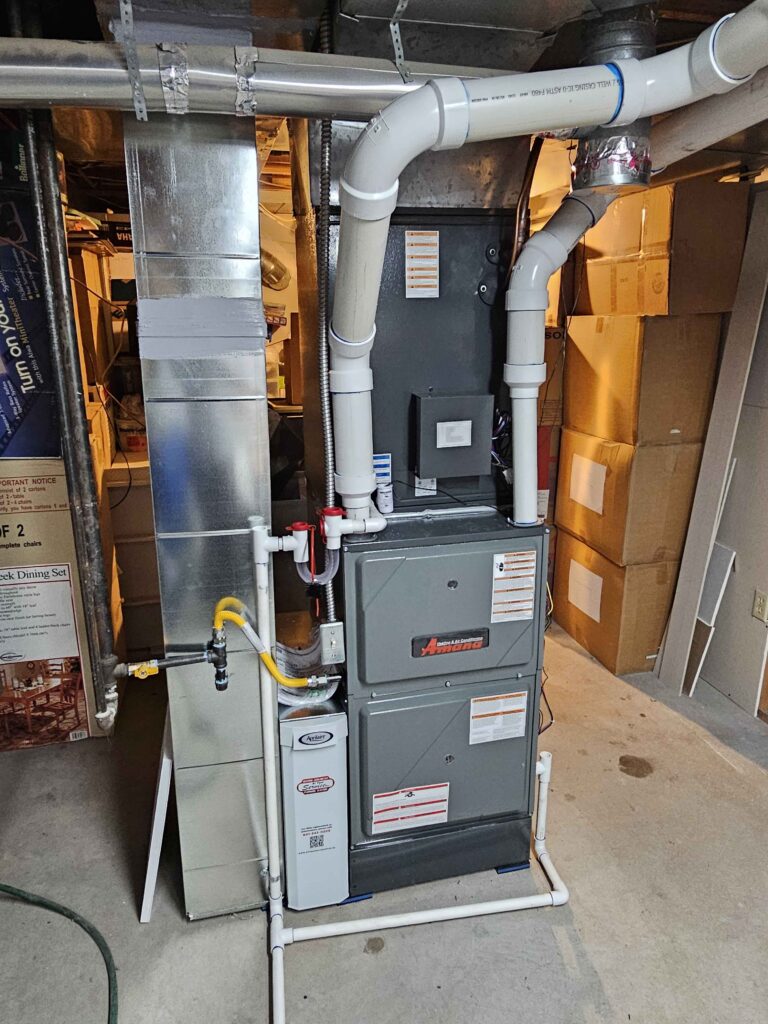
My System: A 97% Furnace, Modulating Gas Valve, and Variable-Speed Motor
For my great-grandfather’s 1,050 sq ft home (currently being restored), I chose:
-
97% efficient furnace
-
Fully modulating gas valve
-
Variable-speed ECM blower motor
-
40,000 BTU downsizing compared to the previous unit
Why modulating, even in a small house?
Because when doors open, weather shifts, or cold air rushes in, the furnace can ramp quickly to correct the temperature—then ramp down again smoothly.
This ensures:
-
No bursts of overly hot air
-
No freezing basement
-
No furnace “roaring” on and off
-
Just consistent, even comfort everywhere
Why the Old System Had to Go
The previous furnace was a:
-
80% efficiency
-
Single-stage
-
PSC blower
-
Completely cracked heat exchanger
-
Total failure risk
It was inefficient, uncomfortable, and unsafe. I wouldn’t put that system in a rental—let alone my own home.
Key Takeaway
After 20+ years in the HVAC industry, I don’t just want equipment that works—I want equipment that delivers comfort, efficiency, air quality, and reliability. That’s why I installed a 97% modulating furnace with a variable-speed motor, properly sized for my home. When you understand how the technology works, the choice becomes clear: the right system is the one designed around your home, your airflow needs, and your family’s comfort.