Clean Doesn’t Mean Healthy: The Hidden Truth About Indoor Air in Utah Homes

At first glance, your home looks spotless.
The counters shine. The floors are vacuumed. The bathroom smells fresh. So naturally, it feels clean.
However, here’s the part most homeowners don’t realize: clean doesn’t always mean healthy — especially when we’re talking about indoor air quality in Utah homes.
In fact, some of the most common indoor air pollutants are completely invisible. So while your house may look pristine on the surface, the air inside could still be affecting your sleep, focus, energy, and even your family’s health.
Let’s take a closer look at the difference between a visually clean home and a truly healthy home — because the gap between the two is bigger than most people think.
First, What “Clean” Usually Means
When people say their house is clean, they’re usually talking about what they can see.
For example:
-
No visible dust
-
No clutter
-
Disinfected surfaces
-
Vacuumed carpets
-
A pleasant scent
And yes, those things absolutely matter.
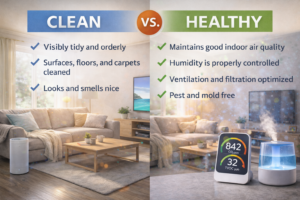
However, visual cleanliness only addresses surface-level dirt and bacteria. It does not measure carbon dioxide (CO₂), volatile organic compounds (VOCs), humidity imbalance, airflow efficiency, or pressure balance.
In other words, a home can sparkle — and still have poor indoor air quality.
Meanwhile, What “Healthy” Actually Means
A healthy home goes beyond appearance.
Instead of focusing only on surfaces, it focuses on air movement, ventilation, and balance. Specifically, healthy indoor air quality means:
-
Balanced humidity levels (30–50%)
-
Proper airflow and pressure balance
-
Low VOC concentrations
-
Consistent fresh air exchange
-
Reduced airborne irritants
According to the U.S. Environmental Protection Agency (EPA), indoor air can be two to five times more polluted than outdoor air. Therefore, even a spotless home in Salt Lake City or Draper can contain elevated indoor air pollutants if ventilation is limited.
So although cleaning is important, it’s only one piece of the puzzle.
Now Let’s Compare: Clean vs. Healthy
To make this clearer, imagine two homes in Sandy.
Home A
-
Sparkling countertops
-
Strong air freshener scent
-
Windows closed all winter
-
No visible dust
Home B
-
Neutral smell
-
Balanced humidity
-
Whole-home ventilation system
-
Proper airflow return pathways
At first glance, Home A looks cleaner.
However, Home B may actually be healthier.
Why? Because scented candles and cleaning sprays can release VOCs. Meanwhile, closed windows and tight construction can trap CO₂ indoors. Over time, that combination affects comfort and cognitive performance — even though everything looks tidy.
Furthermore, Invisible Pollutants Are the Real Issue
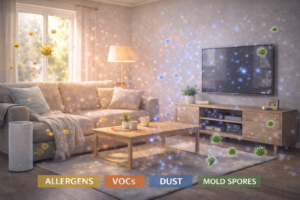
The biggest difference between a clean home and a healthy home is what you can’t see.
Carbon Dioxide (CO₂)
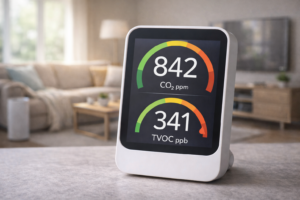
CO₂ builds up naturally from breathing. However, in tightly sealed Utah homes — especially during inversion season — fresh air exchange can be limited.
As a result, indoor CO₂ levels can rise.
Research from Harvard T.H. Chan School of Public Health shows that higher indoor CO₂ levels are associated with reduced cognitive function, increased fatigue, and headaches.
You won’t see it.
You won’t smell it.
But you may feel it.
Volatile Organic Compounds (VOCs)
Ironically, many products designed to make your home smell “clean” release VOCs.
For example:
-
Air fresheners
-
Cleaning sprays
-
New furniture
-
Paint
-
Flooring
-
Cabinet finishes
The EPA notes that VOC exposure can cause irritation, dizziness, and headaches — especially in enclosed spaces.
Therefore, a freshly cleaned room may temporarily have higher VOC levels than before.
Humidity Imbalance
Additionally, humidity plays a major role in healthy indoor air.
In Utah’s dry winter climate, indoor humidity often drops below 30%. Consequently, homeowners may experience:
-
Dry skin
-
Nosebleeds in children
-
Scratchy throats
-
Static electricity
-
Cracking wood floors
On the other hand, excess humidity can encourage mold growth.
Either extreme can exist in a visually clean home.
Because of Utah’s Climate, Ventilation Is Critical
Utah homes are built for energy efficiency. While that helps reduce heating costs, it also limits natural air exchange.
Moreover:
-
Winter heating dries the air significantly.
-
Summer cooling increases airflow velocity.
-
Multi-level homes create pressure differences between floors.
In places like Park City or Heber, elevation changes amplify stack effect — meaning air pressure shifts from floor to floor.
Therefore, home ventilation in Utah isn’t optional. It’s essential for maintaining healthy indoor air quality.
So, How Do You Know If Your Clean Home Isn’t Healthy?
Fortunately, your body often provides clues.
For instance:
-
Do headaches improve when you leave the house?
-
Does fatigue hit harder indoors?
-
Do kids experience winter nosebleeds?
-
Does the air feel heavy or stuffy with doors closed?
If symptoms ease outside, indoor air may be contributing.
Ultimately, Clean and Healthy Should Work Together
Of course, you should keep cleaning. Surface hygiene still matters.
However, if you truly want a healthy home in Utah, you also need:
-
Balanced ventilation
-
Proper HVAC airflow
-
Controlled indoor humidity
-
Reduced VOC sources
-
Stable pressure balance
Whole-home airflow and ventilation systems help ensure that air is consistently refreshed rather than trapped.
Professionals who specialize in indoor comfort — including partners like https://atyourservicepros.us — often discover that once ventilation improves, homeowners immediately feel the difference.
Because in the end, a home shouldn’t just look clean.
It should feel healthy, too.
Need service? Call (801) 609-1551 or schedule an appointment online.
References
-
U.S. Environmental Protection Agency – Introduction to Indoor Air Quality
https://www.epa.gov/indoor-air-quality-iaq/introduction-indoor-air-quality -
U.S. Environmental Protection Agency – Volatile Organic Compounds’ Impact on Indoor Air Quality
https://www.epa.gov/indoor-air-quality-iaq/volatile-organic-compounds-impact-indoor-air-quality -
Harvard T.H. Chan School of Public Health – Indoor Air Quality and Cognitive Function
https://healthybuildings.hsph.harvard.edu/impacts-of-indoor-air-quality-on-cognitive-function/ -
American Society of Heating, Refrigerating and Air-Conditioning Engineers (ASHRAE) – Ventilation Standards 62.1 & 62.2
https://www.ashrae.org/technical-resources/bookstore/standards-62-1-62-2