Leak Free HVAC Systems Start With This Test

If you’ve ever heard your HVAC installer say things like “we brazed it,” “pulled it under 500 microns,” or “it passed the vacuum test,” you’re not alone if it all sounded a little technical. The good news? Those steps are a very big deal for the long-term health, efficiency, and reliability of your heating and cooling system.
Let’s break it down in plain English—Utah neighbor to Utah neighbor.
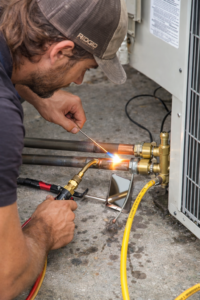
What Is Brazing in HVAC?
Brazing is the process of permanently joining copper refrigerant lines using very high heat and a specialized filler metal (usually a silver alloy). Unlike soldering, brazing melts the filler metal—not the copper itself—allowing it to flow into the joint and create an extremely strong, sealed connection.
In HVAC systems, brazing is used anywhere refrigerant lines are joined, such as when installing a new air conditioner, heat pump, or refrigerant coil.
Why HVAC Techs Braze Instead of Solder
Soldering works fine for plumbing, but HVAC systems operate under much higher pressure and temperature. Refrigerant lines can see pressures well over 400 PSI on hot summer days in places like Sandy or Layton.
Brazing is used instead of soldering because it:
-
Creates stronger, longer-lasting joints
-
Handles high refrigerant pressures safely
-
Resists vibration from system operation
-
Reduces the chance of future refrigerant leaks
In short, brazing helps ensure your system doesn’t slowly lose refrigerant over time—which would hurt efficiency and eventually lead to costly repairs.
What Is a Pressure Test and Why It Matters
After everything is brazed, technicians perform a pressure test, usually with dry nitrogen. This step checks for leaks before refrigerant ever enters the system.
If there’s even a tiny pinhole leak, the pressure won’t hold. Catching that early prevents:
-
Refrigerant loss
-
Moisture entering the system
-
Compressor damage
-
Reduced system lifespan
This is one of those behind-the-scenes steps homeowners never see—but it protects your investment in a big way.
What Is a Vacuum Test and Why 500 Microns Matters
Once the pressure test passes, the system is placed under a deep vacuum using a vacuum pump. This removes:
-
Air
-
Moisture
-
Non-condensable gases
All of those are bad news inside a refrigerant system.
So… What Is a Micron?
A micron is a very small unit of pressure—much smaller than what normal gauges can measure.
-
Atmospheric pressure = about 760,000 microns
-
A properly evacuated HVAC system = 500 microns or lower
Getting below 500 microns means the system is extremely clean and dry inside.
Why the System Has to Hold Under 500 Microns
It’s not enough to just pull the system down to 500 microns—you also have to make sure it stays there.
Manufacturers typically require:
-
The system holds below 500 microns
-
The pressure doesn’t rise above 1,000 microns
-
It holds for at least 15 minutes
If the pressure rises quickly, that tells the technician one of two things:
-
There’s a leak
-
There’s moisture still boiling off inside the system
In your case, holding around 700 microns for an hour is actually an excellent sign. That tells us the system is tight, dry, and installed correctly.

Why Moisture Inside an HVAC System Is Such a Big Problem
Moisture doesn’t just sit there harmlessly. Inside an HVAC system, moisture can:
-
Turn acidic when mixed with refrigerant and oil
-
Damage the compressor (the heart of the system)
-
Freeze and cause restrictions
-
Reduce efficiency and cooling capacity
That’s why proper vacuum testing is just as important as the physical installation.
What All of This Means for Homeowners
For homeowners in places like Draper, Bountiful, or Park City, all this technical work translates into real benefits you can feel:
-
Better energy efficiency
-
More consistent cooling and heating
-
Fewer breakdowns
-
Longer system lifespan
-
Protection of your manufacturer warranty
In other words, these steps aren’t “extra.” They’re what separate a professional installation from a rushed one.
Why Manufacturer Specs Matter
Modern HVAC systems are engineered very precisely. Manufacturers require brazing, pressure testing, and deep vacuum procedures because they know shortcuts lead to failures.
When a system is installed to spec:
-
It runs quieter
-
It lasts longer
-
It performs closer to its rated efficiency
That’s especially important during Utah’s hot summers and cold inversions, when your system is working overtime.
The Bottom Line
Brazing ensures your refrigerant lines are strong and leak-free.
Pressure testing confirms the system is sealed tight.
Vacuum testing under 500 microns proves the system is clean, dry, and ready to run.
Most homeowners never see this work—but it’s one of the biggest reasons a system performs well for 15–20 years instead of failing early.
Need service? Call (801) 609-1551 or schedule an appointment online.