When a Furnace Is Too Dirty to Save: What Homeowners Need to Know

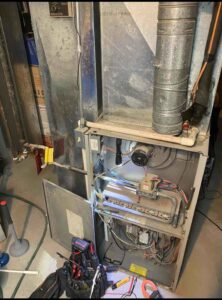
A dirty furnace isn’t just inefficient — it can become genuinely unsafe. In the field, we routinely inspect systems that look perfectly fine from the outside but tell a very different story once the panel comes off. The transcript shared above captures exactly what happens when a furnace is allowed to operate with the wrong air filter and years of unchecked dirt accumulation.
This post breaks down what was happening inside that unit, why dirt is the #1 killer of furnaces, and how homeowners can prevent costly — and dangerous — failures.
The Hidden Damage Inside a Neglected Furnace
When the service tech opened the furnace, the first thing visible was water damage and a complete lack of filtration. The filter wasn’t stopping dirt at all. In fact, dirt fell straight through when touched — like pouring sugar through a screen. That level of porosity means the blower, burners, heat exchanger, and gas valve were taking every bit of airborne debris directly into the combustion chamber.
Over time, this level of contamination becomes unavoidable mechanical stress. Dirt burns, cakes, accumulates, and eventually compromises the metal.
Why Cheap Filters Don’t Protect Your Furnace
Most homeowners choose air filters based on price, but the cheapest pleated or fiberglass filters often do little more than catch large debris. In the video transcript, the technician explains that if you poured salt or sugar onto the filter, it would slip right through.
That means:
-
Fine particulates circulate freely.
-
Dirt coats burners and restricts airflow.
-
The heat exchanger is forced to overheat repeatedly.
-
Dust accumulates inside the gas valve and safety components.
It’s a perfect storm — and completely preventable with a higher-quality filter or upgraded filtration system such as a Reme Halo purifier (available on Healthy Water and Air’s site).
The Consequences: Cracked Heat Exchanger and Unsafe Operation
A furnace can survive age. It can survive wear.
What it can’t survive is dirt.
Because this furnace was both oversized and excessively dirty, the heat exchanger eventually cracked — a non-negotiable safety failure. A cracked heat exchanger can allow combustion gases (including carbon monoxide) to mix into household air. When that happens, replacement is the only safe option.
By the time we see a furnace this contaminated, even cleaning will not restore structural integrity. Components are too heat-stressed, too corroded, and too dust-packed to trust in continued operation.
Dirt: The Number One Killer of Furnaces
As the technician says, “The number one killer of a furnace is dirt.” It’s not a sales pitch — it’s industry truth. Dirt makes blowers strain, burners misfire, gas valves stick, and safety switches trip. It shortens system life more than age, brand, or weather ever will.
This is why our partners at At Your Service Pros recommend annual maintenance and proper filtration for every home, regardless of system age. A simple maintenance routine prevents the kind of catastrophic failure shown in the transcript, saving homeowners thousands in emergency replacement costs.
Protecting Your Furnace (and Your Safety)
Image: “technician replacing HVAC filter high MERV rating”
Alt text: Technician installing a high-efficiency HVAC filter.
Caption: A quality filter is the simplest way to extend furnace life.
Here’s what homeowners can do to prevent premature furnace failure:
Choose the right filter
Use a high-quality pleated filter or a whole-home purification solution like the Reme Halo air purifier for better particle capture.
Get annual professional maintenance
An HVAC tech can catch combustion issues, airflow restrictions, and mechanical wear long before they become safety hazards.
Watch for overheating
Odd smells, loud cycling, or hot furnace cabinets often indicate dust buildup or restricted airflow.
Replace aging systems responsibly
If a furnace has a cracked heat exchanger or severe water/dirt damage, replacement is not optional — it’s a matter of safety.
The Bottom Line
Dirt doesn’t just dirty your furnace — it destroys it. The system in the transcript reached a point where repair wasn’t safe, feasible, or ethical. With proper filtration and routine maintenance, homeowners can avoid this entirely.
References
-
https://healthywaterandairutah.com (product and indoor air quality solutions)
-
https://atyourservicepros.us (HVAC service and maintenance resources)
- https://indoortemp.com/resources/what-is-a-furnace-filter (what is a furnace filter?)
- https://ntinow.edu/the-importance-of-regularly-changing-your-furnace-air-filter/ (regular filter changing)