Why Constant Background Noise Keeps Your Body on Alert

DuringYou may not consciously hear it.
But your body does.
That faint electrical hum. The soft rush of air through vents. The low vibration from appliances cycling on and off. In many Utah homes, these subtle background noises are constant — and over time, they can quietly keep your nervous system on alert.
If you’ve ever felt tired but wired at home, or perhaps noticed you relax more when you leave the house, then background noise may actually be playing a bigger role than you think.
Your Nervous System Is Always Listening
Even when you’re asleep, your brain continues scanning your environment for changes in sound. In fact, this process is a survival mechanism. As a result, sudden or irregular noise can activate your stress response — even if it doesn’t fully wake you.
According to sleep and neuroscience research, low-frequency or intermittent sounds are especially disruptive because they’re unpredictable. The brain treats unpredictability as potential threat.
That means:
-
Electrical buzzing
-
HVAC airflow shifts
-
Vents whistling
-
Duct expansion “pings”
-
Transformer hums
…can keep your body slightly elevated in stress mode.
Not enough to cause panic.
Just enough to prevent deep relaxation.
The Problem With “Invisible” Noise
The tricky part is that background noise fades into awareness. After a few days, you may not consciously notice it at all.
But physiologically, your body still responds.
Research from the World Health Organization has linked environmental noise exposure — even at relatively low levels — to sleep disturbance and stress-related health effects. The key issue isn’t volume alone. It’s consistency and pattern disruption.
When noise fluctuates unpredictably, your nervous system stays semi-alert.
Electrical Hums and Micro-Vibrations
Modern homes are full of electronics:
-
Smart thermostats
-
Wi-Fi routers
-
Chargers
-
LED drivers
-
HVAC control boards
-
Refrigerators and freezers
Many of these devices emit subtle hums or vibrations. In quiet neighborhoods like Draper, Heber, or Bountiful — especially at night — those sounds become more noticeable.
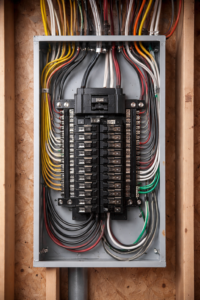
Electrical hum often comes from:
-
Transformers
-
Loose wiring connections
-
Aging HVAC components
-
Circuit load imbalance
While not always dangerous, these sounds signal electrical activity that may need evaluation — particularly if they’re new or increasing.
Airflow Turbulence You Can’t See
Air doesn’t move silently.
For example, when ducts are undersized, blocked, or imbalanced, airflow becomes turbulent rather than smooth.. That turbulence creates:
-
Whistling vents
-
Rushing sounds
-
Low-frequency rumbles
-
Pressure “whooshes” when doors close
Homes in Salt Lake City and Sandy often experience this after renovations or system upgrades that didn’t include airflow recalibration.
Turbulent airflow not only creates noise — it signals inefficiency. And inefficient systems work harder, cycle more frequently, and create more sound variability.
Why This Matters for Stress and Sleep
Your body is wired to relax in predictable, stable environments.
When noise fluctuates:
-
Heart rate subtly increases
-
Cortisol can rise
-
Sleep cycles become lighter
-
Recovery is reduced
The National Sleep Foundation notes that consistent environmental conditions are essential for restorative sleep. Even minor disturbances can fragment deep sleep stages.
If your home never fully “settles,” your body may not either.

Utah Homes and Acoustic Sensitivity
Utah’s climate and construction styles can amplify background noise.
During winter:
-
Ducts expand and contract
-
Furnaces cycle more often
-
Stack effect increases airflow shifts
Over the summer:
-
AC systems run longer
-
Air velocity increases
-
Upper floors experience more turbulence
In the mountain areas like Park City, nighttime quiet makes even small mechanical sounds stand out more.
Over time, that constant low-level stimulation can leave homeowners feeling subtly restless at home — even if they can’t pinpoint why.
Signs Your Home’s Noise May Be Affecting You
Watch for:
-
Feeling calmer outside your home
-
Light sleeping without obvious wake-ups
-
Noticing hums more at night
-
HVAC noises that change with door positions
-
A sense that your house is never truly “quiet”
These are often comfort-system signals, not psychological ones.

How to Reduce Background Noise Stress
Improving home acoustics isn’t about silence — it’s about stability.
-
Balance HVAC airflow to reduce turbulence
-
Tighten or service loose electrical components
-
Inspect ductwork for restrictions
-
Maintain steady temperature settings
-
Address pressure imbalances between rooms
Whole-home airflow and electrical evaluations can identify subtle mechanical sources of stress that homeowners often overlook.
Professionals focused on total home comfort — for example, partners like https://atyourservicepros.us — frequently solve “mystery stress” complaints by first correcting airflow and electrical inconsistencies.
A Calm Home Helps Create a Calm Body
You shouldn’t have to leave your house to feel relaxed.
When airflow is smooth, electrical systems are stable, and background noise is consistent and minimal, your nervous system finally gets the message:
You’re safe. You can rest.
Sometimes improving wellness starts not with your thoughts — but with your home environment.
Need service? Call (801) 609-1551 or schedule an appointment online.
References
-
World Health Organization – Environmental Noise Guidelines for the European Region
https://www.who.int/publications/i/item/9789289053563 -
National Sleep Foundation – How Noise Affects Sleep
https://www.sleepfoundation.org/noise-and-sleep -
Harvard Health Publishing – Understanding the Stress Response
https://www.health.harvard.edu/staying-healthy/understanding-the-stress-response -
U.S. Environmental Protection Agency – Indoor Air and Environmental Quality
https://www.epa.gov/indoor-air-quality-iaq