Why Headaches Disappear When You Leave the House

Ever notice how that dull, nagging headache fades the minute you step outside? You drive away, run errands, grab lunch — and suddenly you feel clearer. Then you come home… and within an hour, it creeps back.
That’s not random. And it’s not “just stress.”
In many Utah homes, recurring indoor headaches are linked to a combination of pressure imbalance, elevated carbon dioxide (CO₂), and volatile organic compounds (VOCs). Alone, each one might be subtle. However, together, they can create the perfect storm for brain fog and head pain.
Let’s break down why this happens — and why leaving the house often brings relief so quickly.
First, Your Air Changes When You Step Outside
The moment you leave your home, you enter a completely different air environment. Outdoor air — even during Utah inversion season — typically has lower CO₂ levels than indoor air. That shift alone can make you feel more alert.
Indoors, CO₂ builds up simply from breathing. In tightly sealed homes across Salt Lake City, Sandy, and Draper, fresh air exchange is often limited, especially in winter.
According to the Environmental Protection Agency (EPA), indoor air pollutant levels can be significantly higher than outdoor levels, particularly in energy-efficient homes with limited ventilation.
So when you walk outside, your brain receives more oxygen relative to CO₂ — and clarity improves.
Next, Pressure Imbalance Affects Your Sinuses
Now let’s talk about pressure.
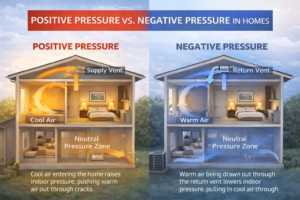
Homes constantly move air. When HVAC systems push conditioned air into rooms without proper return pathways, pressure builds up. Conversely, negative pressure can pull air from attics, crawlspaces, or garages.
That pressure shift can affect:
-
Sinus cavities
-
Inner ear balance
-
Overall head tension
In Utah’s dry climate — especially in places like Layton, Bountiful, or Park City — sinuses are already sensitive. Therefore, even small indoor pressure differences can create discomfort.
When you leave the house, that pressure normalizes. As a result, sinus-related headaches often ease quickly.

Then There’s the VOC Factor
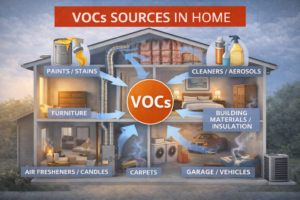
Volatile organic compounds (VOCs) are gases released from:
-
Furniture
-
Cleaning products
-
Paint
-
Flooring
-
Air fresheners
-
Cabinetry
While each product may release small amounts, the combined effect can impact sensitive individuals.
The EPA notes that VOC exposure may cause headaches, dizziness, and irritation — particularly in enclosed indoor spaces.
Even more importantly, VOC levels often spike after:
-
Cleaning
-
Renovations
-
New furniture installation
-
Seasonal temperature changes
So, if your home recently had updates — or if it’s tightly sealed — those chemicals may linger longer than expected.
When you step outside, you dilute that exposure immediately.
Why the Combo Is So Powerful
Here’s where it gets interesting.
Individually:
-
Slightly high CO₂ might cause mild fatigue.
-
Pressure imbalance might create subtle sinus tension.
-
VOCs might irritate your system just a bit.
However, when all three happen at once, symptoms intensify.
It’s not dramatic. It’s cumulative.
For example:
-
Elevated CO₂ reduces alertness.
-
VOCs irritate neurological pathways.
-
Pressure shifts create sinus inflammation.
Together, they produce headaches that mysteriously vanish once you leave.
Why Utah Homes Are Especially Susceptible
Utah homes are built for energy efficiency — which is great for utility bills. However, tighter construction means less natural airflow.
Add in:
-
Long winters with closed windows
-
Inversion season trapping outdoor pollutants
-
Heavy HVAC use
-
Dry air irritating sinuses
…and indoor environments can become more concentrated than homeowners realize.
In mountain communities like Heber or Park City, cold air pooling and stack effect can also increase pressure differences between floors.
Signs Your Headaches Are Environment-Related
Not all headaches are caused by indoor air. However, certain patterns are revealing.
Watch for:
-
Headaches that improve within 30–60 minutes of leaving home
-
Symptoms worse in one room (like a bedroom or office)
-
Increased discomfort after cleaning or renovations
-
Stuffy or heavy indoor air
-
Multiple family members feeling similar symptoms
If those sound familiar, your home’s air may be the common denominator.
What You Can Do About It
The solution isn’t just opening a window — especially during winter.
Instead, focus on:
-
Improving balanced ventilation
-
Reducing VOC sources where possible
-
Supporting proper HVAC airflow return
-
Monitoring CO₂ levels
-
Maintaining steady indoor pressure conditions
Whole-home airflow assessments often uncover pressure imbalances that homeowners never suspected.
Professionals who specialize in indoor comfort — including partners like https://atyourservicepros.us — frequently identify airflow and ventilation issues as the root cause of recurring headaches.
When air moves correctly and fresh air exchange improves, symptoms often decrease significantly.
Clear Head, Clear Air
Your body is incredibly responsive to its environment. Therefore, when headaches disappear outside your home, that’s valuable information.
It’s not “in your head.”
It may be in your air.
When pressure is balanced, CO₂ stays controlled, and VOC levels remain low, your home becomes what it’s supposed to be — a place where you feel clear, comfortable, and well.
Need service? Call (801) 609-1551 or schedule an appointment online.
References
-
U.S. Environmental Protection Agency – Introduction to Indoor Air Quality
https://www.epa.gov/indoor-air-quality-iaq/introduction-indoor-air-quality -
U.S. Environmental Protection Agency – Volatile Organic Compounds’ Impact on Indoor Air Quality
https://www.epa.gov/indoor-air-quality-iaq/volatile-organic-compounds-impact-indoor-air-quality -
Harvard T.H. Chan School of Public Health – Impacts of Indoor Air Quality on Cognitive Function
https://healthybuildings.hsph.harvard.edu/impacts-of-indoor-air-quality-on-cognitive-function/ -
American Society of Heating, Refrigerating and Air-Conditioning Engineers (ASHRAE) – Ventilation for Acceptable Indoor Air Quality
https://www.ashrae.org/technical-resources/bookstore/standards-62-1-62-2