Why You Breathe Through Your Mouth at Night at Home (And How Dry Air May Be the Cause)

If you wake up with a dry mouth, sore throat, or cracked lips, there’s a good chance you’ve been breathing through your mouth while sleeping. Many homeowners across Salt Lake City, Draper, and Layton assume mouth breathing is caused by allergies or congestion.
Sometimes that’s true.
But very often the real issue is something simpler: air dryness and nasal irritation inside the home.
Utah’s climate is extremely dry, and when indoor humidity drops too low, your nose struggles to do its job. As a result, your body switches to mouth breathing during sleep — which can affect sleep quality, hydration, and even overall health.
Let’s look at why this happens and what you can do to fix it.
Your Nose Is Designed to Filter Air
Your nose does more than help you smell. It is actually your body’s natural air filter and humidifier.
When you breathe through your nose, it:
-
Filters dust and particles
-
Adds moisture to the air
-
Warms cold air before it reaches your lungs
-
Helps regulate airflow during sleep
This process protects your respiratory system and supports deeper, healthier breathing.
But here’s the catch: your nose works best when the surrounding air contains enough moisture.
According to the American Academy of Sleep Medicine, nasal breathing improves oxygen exchange and promotes better sleep quality compared to mouth breathing.
When indoor air becomes too dry, the nose struggles to humidify the air effectively. That’s when irritation begins.
Dry Air Irritates Nasal Passages
Utah homes often experience very low indoor humidity levels, especially during winter when heating systems run constantly.
Humidity levels in many homes drop below 20 percent, while health experts recommend 30 to 50 percent indoor humidity for comfort and respiratory health (EPA Indoor Air Quality Guide).
When humidity drops too low, the lining inside your nose dries out.
This can cause:
-
Nasal irritation
-
Swelling in nasal passages
-
Mild congestion
-
Difficulty breathing through the nose
When the nose becomes irritated or blocked, your body naturally switches to breathing through the mouth.
It’s not intentional.
It’s simply your body trying to get enough air.
Mouth Breathing Creates a Cycle
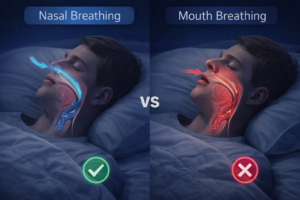
Once mouth breathing starts, it often becomes a cycle.
Breathing through the mouth during sleep can lead to:
-
Dry mouth in the morning
-
Snoring
-
Poor sleep quality
-
Increased throat irritation
According to the Cleveland Clinic, chronic mouth breathing can also contribute to fatigue and headaches because it reduces the efficiency of breathing during sleep.
And here’s the frustrating part: dry air makes the problem worse every night.
Your nasal passages become more irritated, which leads to more mouth breathing, which then dries out your throat and sinuses further.
Over time, sleep quality suffers.
Utah’s Climate Makes the Problem Worse
Living along the Wasatch Front comes with many benefits — but humidity is not one of them.
Utah’s high desert climate means the outdoor air is naturally dry. When that air enters your home and gets heated during winter, humidity drops even further.
Homes in areas like:
-
Salt Lake City
-
Sandy
-
Bountiful
-
Draper
-
Park City
often experience extremely dry indoor air during colder months.
And because modern homes are built to be energy efficient and tightly sealed, dry air can remain trapped inside unless humidity is intentionally added.
That’s why improving indoor air quality in Utah homes often includes adding moisture back into the air.
How Whole-Home Humidity Helps
One of the most effective ways to reduce nighttime mouth breathing is stabilizing indoor humidity.
A whole-home humidifier adds controlled moisture to the air as it circulates through your HVAC system.
This helps:
-
Reduce nasal irritation
-
Improve breathing comfort
-
Protect sinuses
-
Reduce dry skin and static electricity
-
Improve sleep quality
Balanced humidity allows your nasal passages to stay hydrated so they can filter and condition the air properly.
Healthy Water and Air helps homeowners across northern Utah install systems designed to improve indoor air quality and maintain comfortable humidity levels year-round.
Because better breathing at night starts with healthier air.
Signs Your Home Air Is Too Dry
If you’re unsure whether dryness is affecting your sleep, watch for these signs:
-
Dry mouth when waking up
-
Frequent nose irritation or nosebleeds
-
Static electricity around the house
-
Cracked lips or dry skin
-
Increased snoring
If several of these are happening regularly, indoor humidity may be too low.
The good news is that this is often one of the easiest air quality problems to fix.
Creating a Sleep-Friendly Air Environment
Improving nighttime breathing doesn’t always require complicated changes.
Start with a few simple adjustments:
Maintain Healthy Humidity
Aim for 30–50 percent indoor humidity whenever possible.
Improve Air Circulation
Balanced airflow helps distribute humidity evenly throughout the home.
Use High-Quality Filtration
Cleaner air reduces nasal irritation caused by dust and particles.
Evaluate Your HVAC System
Older systems may over-dry air or circulate air unevenly.
If you’ve been waking up with dry mouth or breathing discomfort, your home environment may need attention.
Need service? Call (801) 609-1551 or schedule an appointment online.
Because breathing comfortably through the night shouldn’t depend on luck.
It should depend on healthy air.
References
U.S. Environmental Protection Agency – Indoor Air Quality https://www.epa.gov/report-environment/indoor-air-quality
American Academy of Sleep Medicine – Breathing and Sleep Health https://aasm.org/clinical-resources/practice-standards/practice-guidelines/
Cleveland Clinic – Mouth Breathing and Sleep https://my.clevelandclinic.org/health/diseases/22734-mouth-breathing