Why You Relax Instantly at Hotels (But Not at Home)

Ever notice how you walk into a hotel room and instantly feel calm? The air feels lighter. The temperature feels just right. You breathe deeper without even thinking about it.
Then you come home to Salt Lake City, Sandy, or Draper… and something feels off. Maybe it’s stuffy. Possibly it’s dry. Perhaps the airflow just isn’t the same.
That immediate sense of comfort isn’t accidental. It often comes down to commercial airflow systems vs. residential HVAC systems — and the difference is bigger than most Utah homeowners realize.

The Hidden Power of Commercial Airflow
First, let’s talk about what hotels do differently.
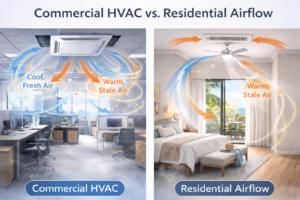
Most hotels use commercial HVAC systems engineered for consistent airflow, balanced humidity, and continuous air exchange. Unlike many residential systems that cycle on and off, commercial systems are often designed to:
-
Circulate air more frequently
-
Introduce controlled fresh air
-
Maintain steady humidity levels
-
Filter air at higher standards
According to the U.S. Environmental Protection Agency, proper ventilation and air exchange are essential for maintaining healthy indoor air quality and comfort (EPA Indoor Air Quality Guide).
In other words, hotels are built to manage air proactively — not just heat and cool it.
And that makes a noticeable difference.
Air Exchange Makes You Feel Better
Now let’s connect that to how you feel.
Commercial buildings typically have higher air changes per hour (ACH) than residential homes. That means stale air gets replaced more often. Carbon dioxide levels stay lower. Fresh air keeps moving.
Research published by Harvard’s T.H. Chan School of Public Health shows that better ventilation improves cognitive function and reduces feelings of fatigue (Harvard Healthy Buildings Study).
So when you relax in a hotel room, it’s not just psychological.
Your brain is literally getting better air.
Meanwhile, many Utah homes — especially tightly sealed newer builds in Park City or Layton — trap indoor air to improve energy efficiency. While that saves on heating bills during inversion season, it can also reduce fresh airflow if not properly balanced.
That’s where residential systems often fall short.
Humidity Is the Game-Changer in Utah
Here’s where things get very local.
Utah’s climate is extremely dry. In winter, indoor humidity levels can drop below 20%. That dry air can cause:
-
Dry skin and irritated sinuses
-
Static electricity
-
Poor sleep
-
Respiratory discomfort
Hotels, especially higher-end ones, often use centralized humidity control to maintain balanced levels year-round. Balanced humidity (around 30–50%) has been shown to improve comfort and reduce airborne irritants, according to the Mayo Clinic and ASHRAE recommendations.
At home, without a whole-home humidifier, your air may feel sharp or uncomfortable — even if the temperature reads 72 degrees.
If you’ve ever woken up congested in Bountiful or Heber but slept peacefully in a hotel downtown, humidity may be the missing piece.
Installing a system designed to improve indoor air quality can dramatically change how your home feels — especially during Utah’s long heating season.
Because temperature alone doesn’t equal comfort.
Filtration Standards Are Often Higher in Hotels
Next, let’s talk about filtration.
Commercial properties frequently use higher MERV-rated filters and advanced air purification systems to maintain guest comfort and meet building codes.
Better filtration means:
-
Fewer airborne particles
-
Less dust
-
Reduced allergens
-
Cleaner-smelling air
ASHRAE (American Society of Heating, Refrigerating and Air-Conditioning Engineers) outlines ventilation and filtration standards that commercial properties must follow (ASHRAE Standards Overview).
In contrast, many homes rely on basic 1-inch filters that primarily protect the furnace — not your lungs.
Upgrading to high-efficiency filtration or adding an air purification system can help your home mimic that “hotel air” feeling. Healthy Water and Air offers residential solutions tailored for Utah homeowners who want cleaner, more balanced airflow.
And once you experience that difference, it’s hard to go back.
Airflow Design: Even Distribution Matters
Have you noticed how hotel rooms rarely have hot and cold spots?
That’s intentional.
Commercial airflow systems are carefully balanced to distribute air evenly throughout the space. Residential homes, however, often deal with:
-
Uneven airflow between floors
-
Overheated upstairs bedrooms
-
Cold basements
-
Weak return air circulation
Especially in multi-level homes in Draper or Sandy, poor airflow balancing can create microclimates inside your house.
Professional HVAC balancing and duct adjustments can dramatically improve airflow consistency. Sometimes it’s not about replacing the system — it’s about optimizing what you already have.
Small airflow changes can create big comfort improvements.
Why Energy Efficiency Changed Home Air
Over the past 20 years, homes have become more airtight to improve energy efficiency. While that’s great for lowering utility bills, it also means:
-
Less natural ventilation
-
More trapped indoor pollutants
-
Increased reliance on mechanical airflow
According to the Department of Energy, tightly sealed homes require proper ventilation strategies to maintain healthy indoor air (Energy.gov Ventilation Guide).
Without it, your home can feel heavy compared to the fresh, continuously managed air inside commercial spaces like hotels.
That “relaxed” feeling? It’s engineered.
But you can engineer it at home too.
Bringing Hotel Comfort Home
So how do you recreate that calm, hotel-like atmosphere in your own house?
Start with the fundamentals:
Upgrade Ventilation
Consider systems that increase controlled fresh air exchange without sacrificing efficiency.

Add Whole-Home Humidity Control
Balanced humidity improves comfort, sleep, and breathing — especially in Utah’s dry winters.
Improve Air Filtration
Higher-efficiency filters or air purification systems can reduce dust and allergens.
Schedule HVAC Optimization
Air balancing and airflow adjustments can eliminate hot and cold spots.
Healthy Water and Air works with homeowners across Salt Lake City, Park City, Layton, and surrounding communities to optimize residential HVAC systems for better comfort and indoor air quality.
Because your home should feel better than a hotel — not worse.
If your air feels stuffy, uneven, or overly dry, it may be time to improve your airflow system.
Need service? Call (801) 609-1551 or schedule an appointment online.
References
-
U.S. Environmental Protection Agency – Indoor Air Quality: https://www.epa.gov/report-environment/indoor-air-quality
-
Harvard T.H. Chan School – Healthy Buildings Study: https://healthybuildings.hsph.harvard.edu/research/
-
ASHRAE Standards and Guidelines: https://www.ashrae.org/technical-resources/standards-and-guidelines
-
U.S. Department of Energy – Home Ventilation: https://www.energy.gov/energysaver/ventilation